Vika Taylor Vertical city scroll demo Design demo · Sky Streets is not a real city MMXXVI YouTube
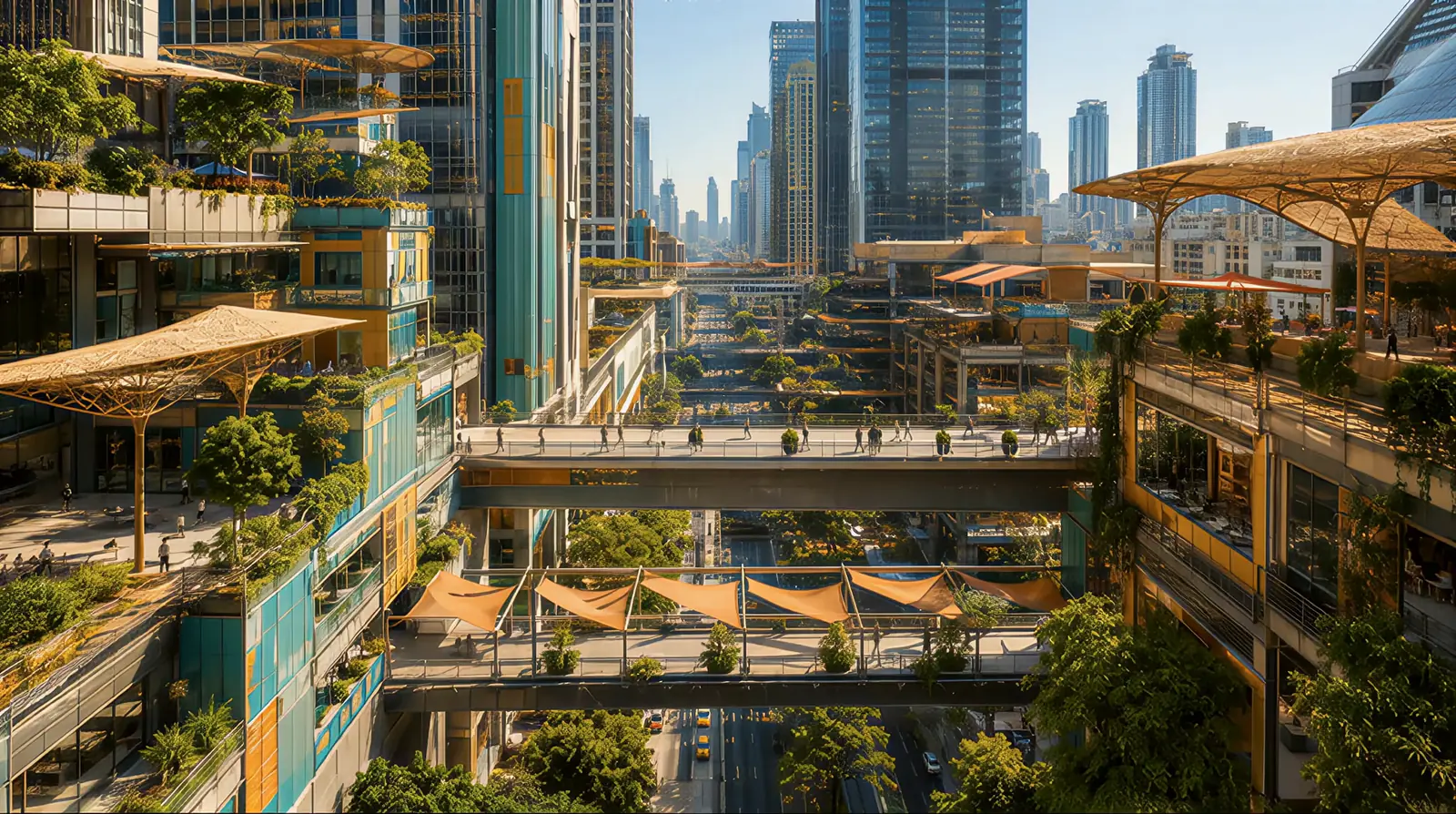
Elevated pedestrian decks running between tropical towers, several levels above the ground
Sky Streets Fictional city · AI-generated film

Cities that Grow up, Not out

A field guide to the layered city: where the ground floor happens on five levels at once.

The ground is not the ground

It is the fifth floor

And the third, and the ninth

03 : The vertical layer

One city, Stacked

Public space does not sit at the bottom of this city. It climbs. Pedestrian decks bridge tower to tower, stairs land inside markets, and every few floors the structure widens far enough to hold a street: benches, food, shade, noise. The section drawing is the city plan.

05
Levels of continuous public walkway, river deck to canopy terrace.
0
Cars on the upper decks. Freight runs below, people move above.
12min
From any home to any other level on foot, never touching the road.

Sky Streets is a fictional concept: these three figures are world-building copy, not measurements.

How the shade works
A teal architectural drawing of glass towers joined by stacked woven footbridges, with planted balconies and woven canopies
04 : Chapter two

Life under the canopy

Shade is infrastructure. Everything else follows from it.

Broad woven canopies on slender stems shading an upper deck, with people walking between the planters

The canopy

Woven overhead structures set the terms for everything underneath: temperature, walking routes, where people stop. The canopy is drawn first and the buildings hang from it. Rattan and bamboo lattices break the sun into working shade, and the airflow between decks does the rest.

A resident in a conical straw hat, a teal bomber jacket and wide mustard utility trousers walking a sunlit street

What people wear

A permanently shaded, humid, walkable city produces its own street style: technical fabrics that dry between levels, wide utility trousers cut for stairs, layered sun protection for the gaps where the canopy opens. The conical hat comes back as everyday gear, not costume.

05 : Manifesto

Manifesto: four principles

Four principles, sideways
  1. 01

    Build upward, walk outward

    Density buys distance. The taller the block, the longer the walk it pays for.

  2. 02

    Plant the structure, not the roof

    Greenery belongs in the frame, on every level, not parked on the top slab.

  3. 03

    Shade Before facade

    Draw the canopy first. The elevation is whatever is left underneath it.

  4. 04

    Every level is a ground floor

    A door, a bench and a stall make a street. The height it sits at is trivia.

Scroll 04
An upper deck walkway in late afternoon sun, glass towers and woven canopies behind a planted balustrade

The city is Not flat anymore

A resident in a conical hat and utility wear walking toward the viewer on the upper deck
Behind the demo

Not a real city

Sky Streets is a fictional concept. There is no such city, company or product, and the figures on this page - five levels, no cars, twelve minutes - are part of the fiction, not measurements of anything that exists.

It is a design demo by Vika Taylor, designed in Claude Design and rebuilt as static HTML, CSS and plain JavaScript. Every picture on this page was made with AI image models. The scroll film was generated with Wan 3.0 from a first and a last frame: the build video runs that image pair and one prompt through two video models, Wan 3.0 and Seedance 2.5, and the Wan 3.0 result is the film at the top of this page.

Questions about this page

Is Sky Streets a real city?

No. Sky Streets is a fictional vertical-city concept, written and designed as a demo. There is no such city, company or product, and the figures on the page - five levels of public walkway, no cars on the upper decks, twelve minutes across on foot - are world-building copy, not measurements.

How does the scroll-driven hero work?

The film is never played. It was cut into all 298 of its frames, and the scroll position picks the frame that is drawn on a canvas, so the film moves exactly as far as you scroll, forwards or backwards, with a short easing between neighboring frames. Phones get a narrower cut of the same frames. Frames arrive in order of need: a coarse set first, then the frames around the one on screen, so the film is usable before all of it has loaded.

What was this page built with?

It was designed in Claude Design, then rebuilt as static HTML, CSS and plain JavaScript - no framework, no build step, no third-party runtime - so every word of the copy is in the initial HTML response. The pictures were made with AI image models, and the hero film was generated with the Wan 3.0 video model from a first and a last frame, before the page was built.

What happens if the film does not load?

The page crossfades two stills instead: the first and the last frame of the film. The same fallback covers a data-saving or very slow connection, a browser that cannot show AVIF images, and frames that fail to arrive. With reduced motion switched on, or without JavaScript, the page is an ordinary scrolling page with a still image at the top.

The build video

Watch it being built

Sky Streets was designed in Claude Design. For the hero, one pair of images, the first and the last frame, and one prompt went through two video models, Wan 3.0 and Seedance 2.5, and the Wan 3.0 result became the scroll film at the top of this page. The video compares the two and shows the page coming together.

Plays from YouTube. Nothing is requested from YouTube until you press play. Pressing play loads Google's player from youtube-nocookie.com, or opens the video on youtube.com where the player cannot be embedded; either way Google receives your IP address and device details. How that works.

Wan 3.0 3D Scroll Website in Claude Design - Better Than Seedance 2.5?

Vika Taylor Published 31 August 2026 4 min 21 s Open on YouTube (opens in a new tab)